Skip to content

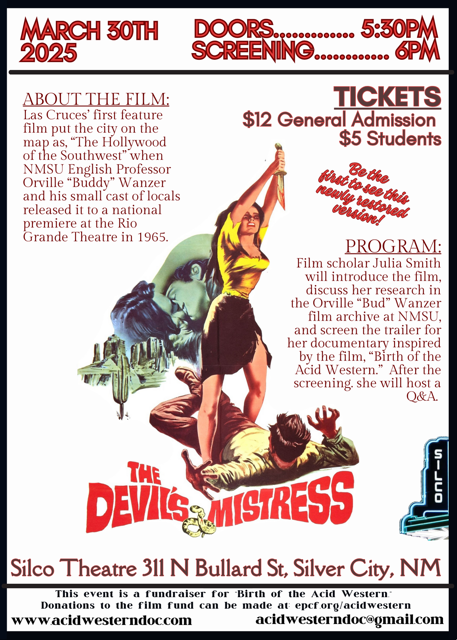
Long before the “Acid Western” had a name, The Devil’s Mistress was redefining the genre. Shot in 1965 by NMSU professor Orville “Buddy” Wanzer with a cast of Las Cruces locals, this trailblazing indie film put Southern New Mexico on the cinematic map. Now, after years in obscurity, it returns in a newly restored version for a special one-night-only screening at the Silco Theatre in Silver City.

Film scholar Julia Smith will introduce the film, share insights from the Orville “Bud” Wanzer archives at NMSU, and present a trailer for her documentary, Birth of the Acid Western. A Q&A will follow the screening.

This event is also a fundraiser for Birth of the Acid Western, a documentary exploring the forgotten legacy of Wanzer’s work and its impact on the genre. Donations to support the film’s completion can be made at the event or online.

March 30, 2025
Silco Theatre, Silver City, NM
$12 General Admission | $5 Students

Be part of film history—see the film that helped define a genre and support the documentary bringing its story to life.
Disclaimer:
The views expressed here are those of the author and do not necessarily reflect those of the Southwest Word Fiesta™ or its steering committee.

TOSC-ANIMATION2
Enriching Life Through Learning in Community

We respectfully acknowledge that the entirety of southwestern New Mexico is the traditional territory, since time immemorial, of the Chis-Nde, also known as the people of the Chiricahua Apache Nation. The Chiricahua Apache Nation is recognized as a sovereign Native Nation by the United States in the Treaty of Amity, Commerce, and Friendship of 1 July 1852 (10 Stat. 979) (Treaty of Santa Fe ratified 23 March 1853 and proclaimed by President Franklin Pierce 25 March 1853).

Related Articles

Mimbres Press Logo Large

Mimbres Press of Western New Mexico University is a traditional academic press that welcomes agented and unagented submissions in the following genres: literary fiction, creative non-fiction, essays, memoir, poetry, children’s books, historical fiction, and academic books. We are particularly interested in academic work and commercial work with a strong social message, including but not limited to works of history, reportage, biography, anthropology, culture, human rights, and the natural world. We will also consider selective works of national and global significance.