JJ Wilson has kindly shared with us his recent review of Sonoran Strange, a compelling debut volume by poet Logan Phillips. The review was originally posted here on JJ’s blog.
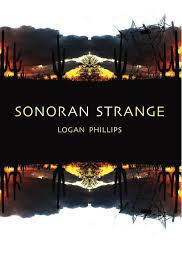 Logan Phillips’s Sonoran Strange is a magnificent debut, awash with poems full of wit and stunning imagery. As one would expect from the title, the collection is strongly rooted in its sense of place. Deserts, canyons, rocks, wide skies abound. Yet the best poems in the collection transcend this locale.
The author is clearly one engaged citizen. He writes about historical injustices and present-day political follies; about the femicides in Ciudad Juárez and about rapacious Man’s misuse of natural resources. But he never rants. He writes with a raised eyebrow, not a raised voice. And his command of rhythm and poetic texture is superb.
Highlights, for me, are the moving “In Ciudad Juárez They Say the Night is a Thief” and the comic “Lupe, Real Talk (Over Raspados).” These two poems show Phillips’s range: he can go from a lyrical meditation about a murder victim to mimicry of a frazzled, foul-mouthed chica somewhere north of the border.
His signature style is the use of lists and repetition to gain rhythm and power, plus occasional forays into Spanish. He also uses myth, for example prominently featuring an updated version of the legend of La Llorona (the weeping woman who drowned her children). Here La Llorona is seen in a hoodie – speaking on a payphone, squatting in a backyard, hanging out by a canal.
What underpins the collection, though, even more than its rallying cries, is the author’s love of language. The collection begins with “Naming Arizona”, which is simply a list of place names (“Oposura, Cosarui, Jocome”), and ends with “Naming: Tombstone” (“Greaterville, Harshaw, Silverbell”). In between, we get names and words that seem to belong in a biology textbook: poems called “Salsola Tragus,” “Canto Rillito,” and “Cylindropuntia Fulgida.” And Phillips delights in all those borrowed words that describe nature: saguaros in bloom, ocotillo forests, jumping cholla, clouds called libélula and golondrina. It doesn’t matter that you don’t know what these are: the language itself brings joy and mystery.
-JJ Wilson, Writer in Residence at Western New Mexico University