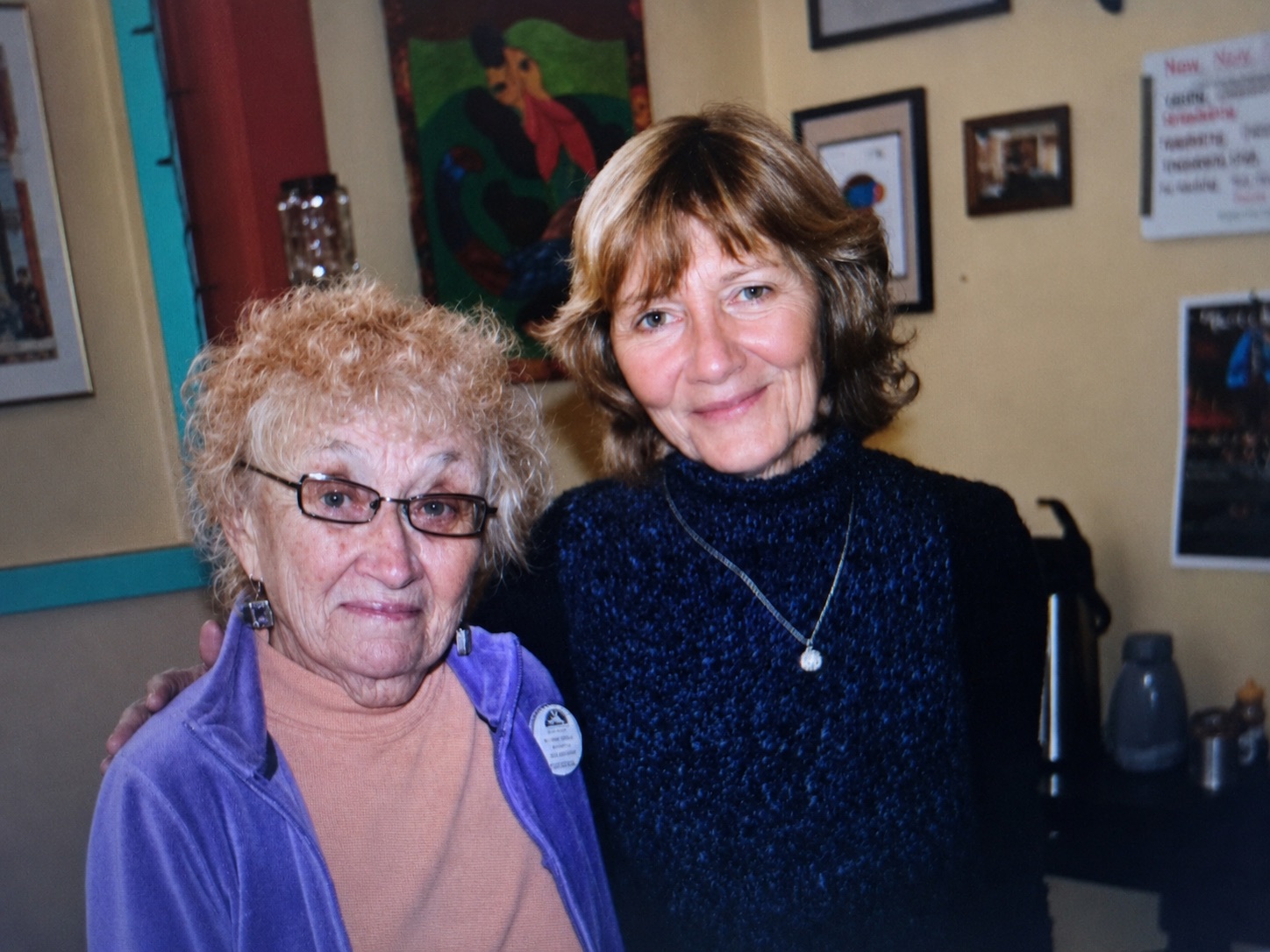
This writing will not be a history of all the monumental things that Bonnie did and the awards she won for her writing and her community work. As important as they are, this is a personal kind of tribute. I have been so very fortunate to know Bonnie, as a friend and fellow poet.
We met at the poetry critique group that Larry Godfrey used to hold in his home almost 20 years ago. We came to know each other through our poetry, our histories speaking to each other. We discovered our mothers were so alike they probably would’ve hated each other. Both of them had expansive ideas that could not fit into a Minnesota town or a farm in Montana. Both of them left their children behind and went their own way. Bonnie could have played the victim of a difficult childhood, but she did not. Instead, she and her brother, Pat, figured out how to make dinners from Spam and not much else, to feed all four children. And she always had her books, kept in the apple crate . . .
When her eyesight made it difficult to read, due to an eye condition in her later years, she started putting her poems in 16 font, bold, so she could read them using the flashlight on her phone. When that didn’t work anymore, she memorized them for readings! This exemplified her character. Always finding a way . . .
She lived not far the Buckhorn Restaurant and Opera House, and would occasionally go out on Friday nights with her friend, Connie, loving the music, sitting by the fire. The first time I saw her she was at a music concert with her husband, Librado. I was sitting behind them. They looked like such an interesting couple. He was tall and dark and she was blonde and quite short. I didn’t know them yet, but there was something about them. Later I began to hear all they had done for the community.
Bonnie knew how to listen and also how to tell you what needed to be said. Very succinctly. Honest but kind. Courageous. She had a deep laugh, a chuckle, that she used, even with herself, when she saw the irony of things. There was always an on-going writing project, but she also took time to sit in solitude, in the company of birds and flowers. Bonnie was the kind of friend you could depend on to tell you the truth, and I shall miss her most for that.
~Elise Stuart
Wednesday 3:24 a.m.
Dedicated to Bonnie Buckley Maldonado
On a hot June morning,
a bag of apricots sits on the table,
on its way to be delivered
to the woman who just―
left her body.
Her spirit, too immense to stay
in that fragile frame any longer,
bursts forth from this world to the next,
leaving behind her treasure of stories,
her poems, her wisdom . . .
and all the people she touched
with her brightness, her fierce adherence to truth,
her willingness to tell you exactly what she thought.
She makes the journey,
unshackled from this sphere,
to the invisible place,
trailing, in her wake,
all petty grievances,
arguments, great losses,
no longer a concern.
She rises above to become
pure Light,
in a vast landscape of beauty and love.
From this viewpoint she sees
not just the tiny bag of fruit,
but the whole apricot tree,
its roots, its trunk,
its blushing apricots,
hanging onto the tips of branches,
reaching toward the sun.
Elise Stuart