Encouragement, inspiration and prompts for writers by Eve West Bessier, Poet Laureate of Silver City and Grant County, New Mexico
Whether you are working in the genre of memoir or not, you can put a lot of yourself into your writing, and that’s what you want to do. In any genre, having an intimate perspective is key. Even in journalism, it’s courageous personal perspective that lands the Pulitzer Prize.
So let’s get up close and personal. That’s not as simple as it sounds, heck it doesn’t even sound simple! We live in a culture of avoidance, at times downright denial of all things personal because that requires intimacy, emotional intelligence and a willingness to go deeper. Most people in our culture would rather order their personality online and live a cookie-cutter life than explore what longs to expand beyond the boundaries of social norms.
The needed social distancing during our current pandemic is not helping to support greater interpersonal intimacy either. As writers, we have a unique opportunity to reach out to others through the written word, which requires no mask, no distancing. So, as writers what can we do to break through our cultural resistance to intimacy and reach our readers?
This may seem counter-intuitive, quite the opposite of what we may think needs to happen, but what we need to do is get seriously objective with your subject. Excuse me? What? Doesn’t objectivity mean distance, not intimacy? So it seems at first, but when we become objective, scientific in our observation, we can get very, very close to our subject without losing our clear perspective. We can get deep without getting lost.
Let me make a case for this by moving to another art form for a moment. In photography, the camera lens objectively frames a subject. The aesthetic is to isolate the focal point of the desired image from the noise of the background, thereby highlighting what you want to portray.
Wait! Aren’t we talking about getting close? Doesn’t isolate mean the opposite? It can, but it can also bring the focus of attention to exactly the stuff of intimacy, and that’s what you want in a photograph.
That’s also what we want in our writing. We want to isolate and highlight our subject from the noisy background to bring it into focus which allows for intimacy. We do that by using the lens of our own perception and experience to create clear, strong imagery with language.
Think about the word imagery for a moment. Remind you of anything? Imagine and imagination. What we love about reading is being able to imagine the scene. In photography and film that is done for us, in reading we get to use our own imagination. That means the level of intimacy can be even greater in the world of words because, as readers, we are bringing our own reservoirs of imagery and emotion into the process.
As writers, our job is to make that experience easy and fulfilling for our readers. We do this by carefully observing our subject, getting up close and personal with it in order to find the right light, the best angle, the clearest focal length. This requires skill, but it’s not a formulaic. It’s a process of experimentation, of careful attention. We need to get inside of the poetic line, inside of the fictional character, inside of our own character. What are we experiencing as we write and how do we infuse this emotion, this insight, this personal neurological lightning into our language? Even if we’re trying to describe a reality-phobic culture, we need to do it with a reality-sensing lens.
Here’s a prompt that will help us get in focus and practice bringing our subject into the spotlight and out of the background chaos, and there certainly is a lot of chaos out there!
Let’s go back to photography again for a moment. Let’s create a still-life portrait with the lens of language. A brilliant photograph doesn’t just capture the subject’s physical form, it captures the essence of the moment in which the subject is present.
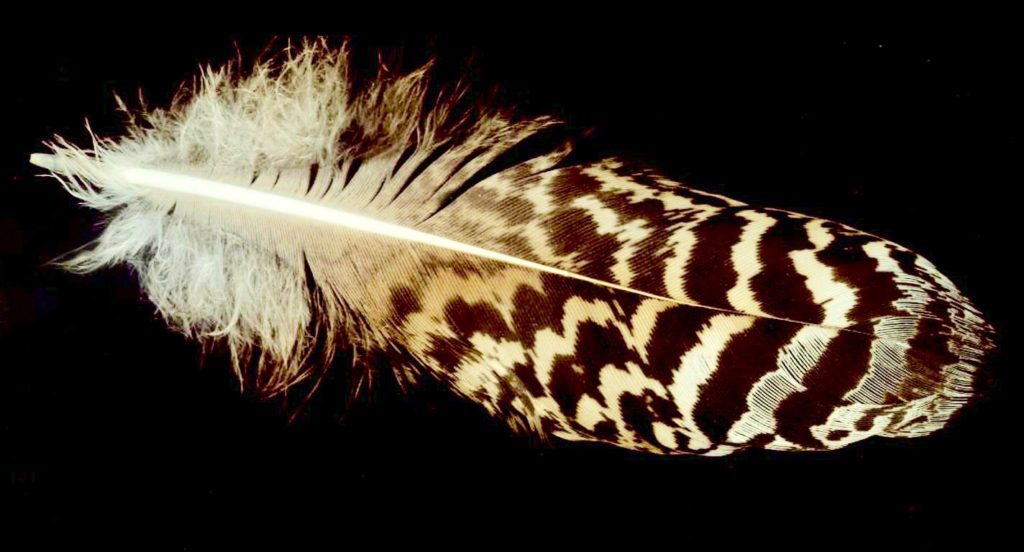
Pick something simple to photograph with words, maybe that hawk feather you found on the trail yesterday. First use your eyes to zoom in on the details. See your subject as if you’ve never seen it before. Use a telephoto lens. Describe the feather so that someone reading your description can see that feather in exquisite detail and can also experience the feather’s deeper meaning. As you see and describe this feather more and more precisely, you will begin to experience the deeper significance of what it represents: flight. How does the metaphor of flight play into the description? How can you bring the experience of flight into focus so that the reader is given wings? This deep observation and intimate description is soulful stuff.
Of course, you don’t have to pick a feather. Pick whatever subject moves you and don’t be afraid to create lots and lots of images. This is the digital age, you aren’t wasting any film!
Scroll down to About The Author for more information and check out Eve’s website at: www.jazzpoeteve.com.